Technical SEO problems are rarely difficult because there is no information.
They are difficult because there is too much of it.
A crawl can produce hundreds of URLs, warnings, measurements and technical details. The challenge is working out what matters first, what is actually supported by evidence, and what can wait.
That is why we built NOTABIS SEO.
NOTABIS SEO is now available in open beta at seo.notabis.com, giving site owners, developers, marketers and small teams a practical way to inspect a website and turn crawl data into a clearer next-step list.
It is designed around a few straightforward questions:
- Can the important pages be reached and crawled?
- Do the pages communicate their purpose clearly?
- Are there broken links, duplicate signals or missing metadata?
- What did the crawler actually measure?
- Which problem should be fixed first?
An audit should explain more than a score
A single number can be useful as a quick summary, but it is not an explanation. An SEO score is not a Google score, and it cannot guarantee a ranking change.
NOTABIS SEO treats the overall score as a summary of the checks measured during a particular crawl. The report also shows the evidence behind the result: affected pages, recorded measurements, issue explanations, crawl coverage and the limitations that may have affected the audit.
The aim is to help you decide what to do next, not to give you another number to chase.
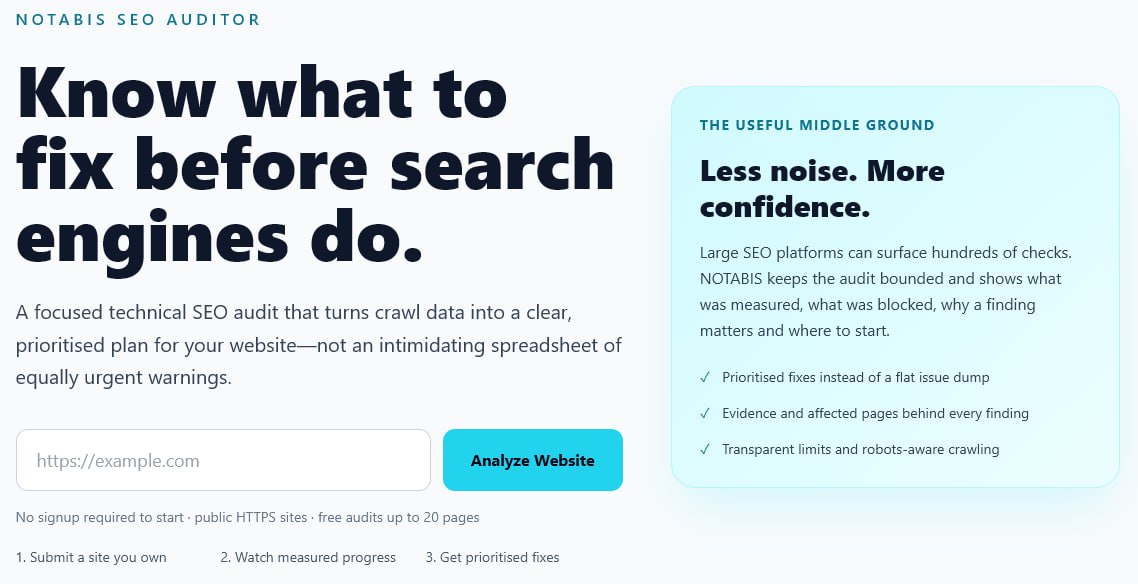
Start with a bounded crawl
NOTABIS SEO begins with a submitted HTTPS website and a bounded crawl. The crawler stays on the submitted origin, respects robots.txt rules and applies limits to pages, requests and response sizes.
That makes the result more predictable and keeps the product focused on useful technical evidence rather than attempting to crawl the entire web.
The current beta supports:
- public HTTPS websites;
- same-origin page discovery;
- robots-aware crawling;
- bounded redirects and requests;
- pages, links, metadata and structured-data signals;
- sitemap and crawlability diagnostics;
- clear handling of timeouts, HTTP errors, DNS failures, TLS failures and edge blocks.
A crawl can be limited or incomplete. A website protected by authentication, an edge challenge or restrictive network policy may not provide the same coverage as a publicly accessible site. NOTABIS SEO is intended to report that limitation honestly rather than quietly presenting a partial result as a complete audit.
Find the issues that affect real pages
The audit examines the signals that shape how a site can be crawled, understood and used. Depending on the pages and evidence available, that includes areas such as:
- crawlability and HTTP responses;
- redirects and canonical URLs;
- page titles and meta descriptions;
- headings and page structure;
- language and content signals;
- images and alternative text;
- internal links and broken destinations;
- duplicate metadata and content patterns;
- structured data signals;
- sitemap discovery and reconciliation;
- AI-search and machine-readable page signals;
- SEO-relevant performance and rendering observations.
These checks are not all equally important. A missing title on a key page may deserve attention sooner than an informational warning on a low-value URL. A blocked page should not be treated as healthy simply because the crawler could not inspect it. Context matters.
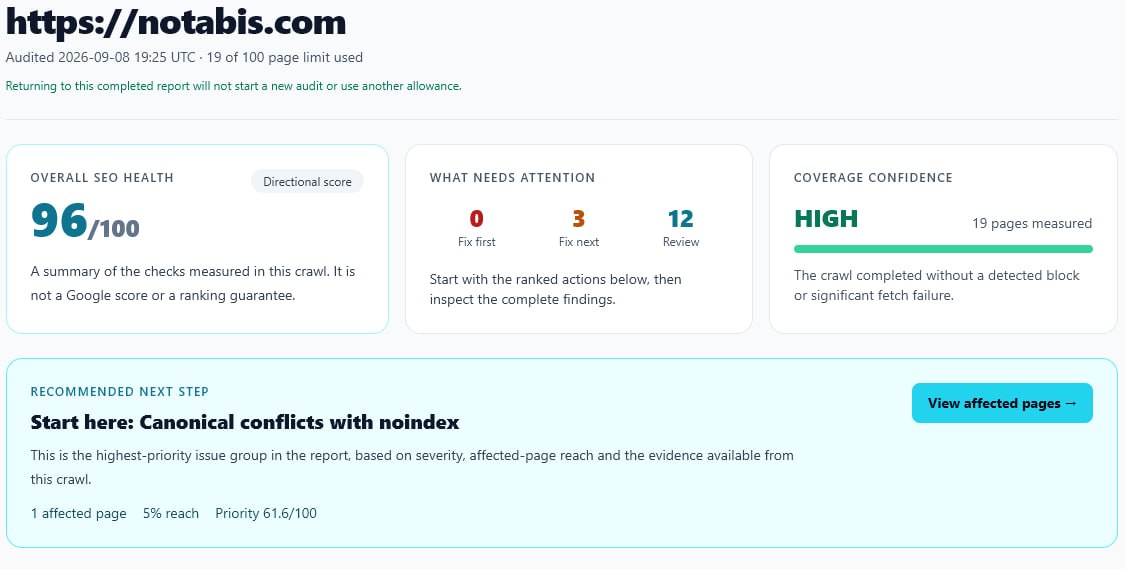
Fix First: a shorter path through a long report
The report groups findings into prioritised actions instead of presenting every warning as equally urgent.
The Fix First recommendation considers factors such as severity, affected-page reach and the evidence available from the crawl. It gives you a place to begin, while still allowing you to inspect the full findings and the reasoning behind the order.
For each issue group, you can see:
- what was observed;
- how many pages are affected;
- how broadly the issue reaches across the crawl;
- why the finding has its current priority;
- links to the affected-page evidence;
- a more detailed explanation where one is available.
This is deliberately different from claiming that every warning must be fixed immediately. Some findings are advisory. Some are intentional. Some need review because the available evidence is incomplete.
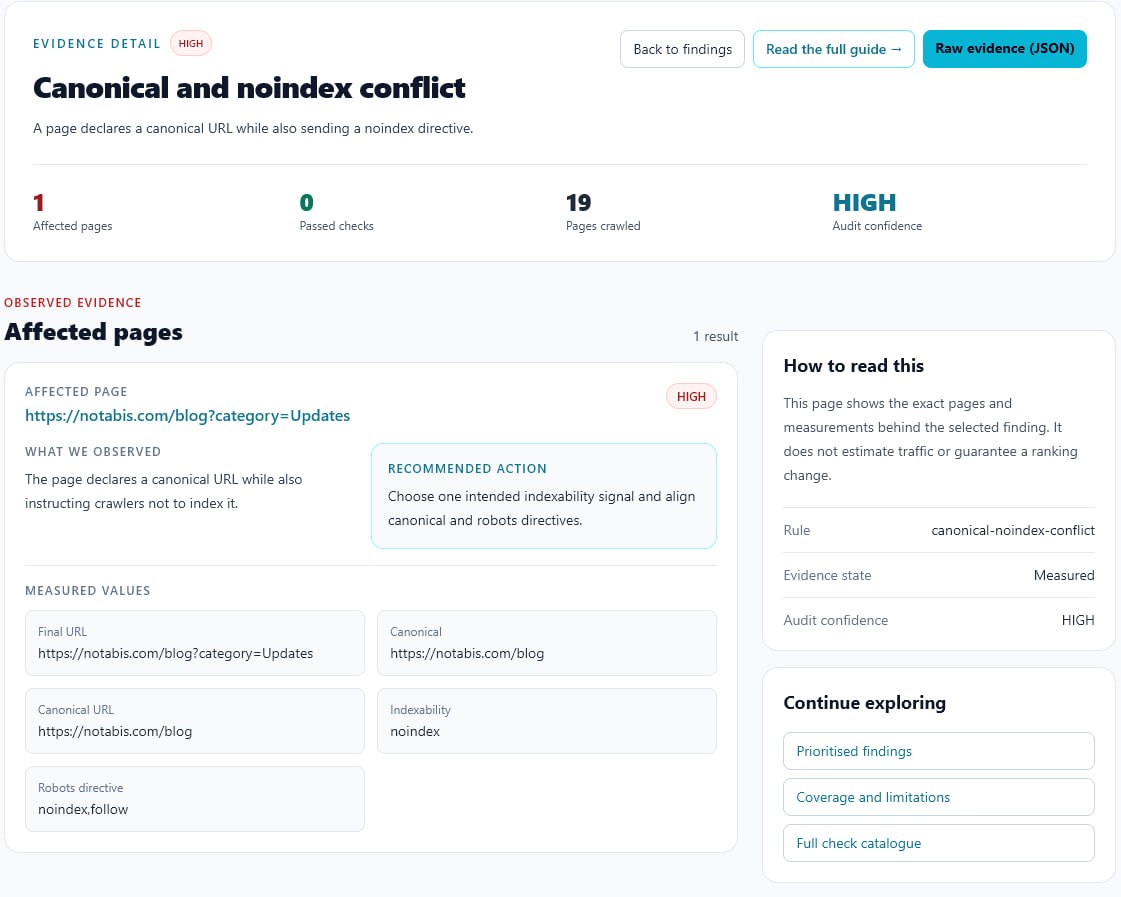
Evidence behind every useful finding
A report becomes much more useful when it helps you verify the result.
NOTABIS SEO links findings to the pages and measurements that produced them. You can open the affected-page view for a selected issue, inspect the observed evidence and return to the wider report without losing the context.
Depending on the finding, evidence can include details such as:
- the affected URL;
- HTTP status and final URL;
- redirect information;
- title, description and canonical values;
- heading and image measurements;
- link destinations and status results;
- structured-data observations;
- crawl and sitemap diagnostics;
- confidence and coverage information.
The product does not pretend that a crawler knows everything about a site. It reports what it measured, separates incomplete coverage from healthy evidence, and avoids turning a technical observation into a ranking promise.
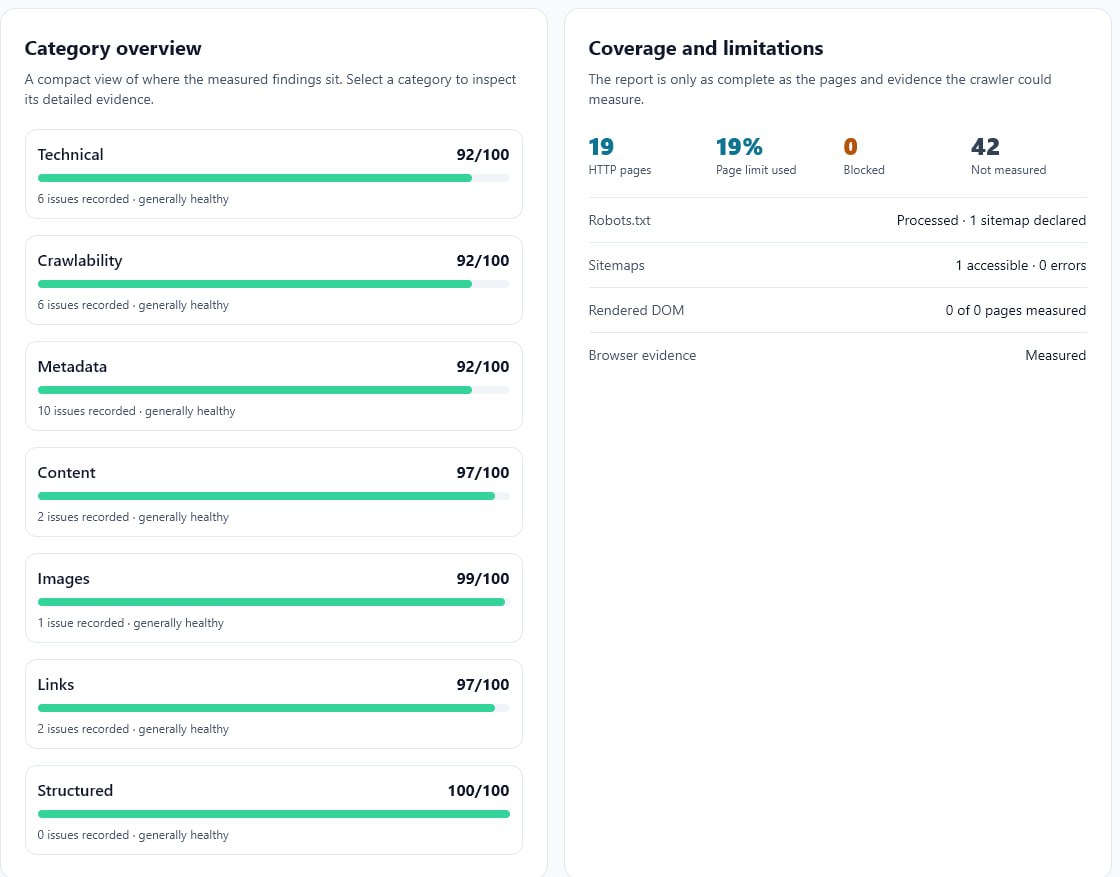
See the site as a collection of pages
A homepage can look fine while important internal pages contain broken links, missing metadata or inconsistent signals.
That is why the report includes more than a summary. Page-level views help you move from a site-wide pattern to the individual URLs that need attention. The crawl and coverage sections also show how many pages were measured, what was blocked or incomplete, and where the result has limits.
Rendered screenshots may be available when browser coverage succeeds. They are useful for checking what a page looked like during the audit, but they are evidence of the captured rendering—not a replacement for the HTTP crawl or a full browser compatibility audit.
The same principle applies to performance observations. NOTABIS SEO reports measurements that it can actually collect in the current audit path. It does not invent Core Web Vitals or claim to be a complete Lighthouse replacement when those measurements are unavailable.
Export and keep working
An audit should fit into the rest of your work.
Completed reports can be revisited through their report link, and the product provides export and evidence paths for taking the results into a wider review process. Authenticated users can keep audit history in their NOTABIS Account rather than relying only on a browser-local link.
Returning to a completed report does not start another crawl or use another allowance. That makes it safer to share a report internally, review a recommendation later or return to the evidence while a fix is being prepared.
Built for practical SEO work
NOTABIS SEO is aimed at people who need a useful technical baseline without immediately assembling a large SEO platform or interpreting an intimidating spreadsheet.
That includes:
- site owners checking a new or established website;
- developers reviewing technical changes before release;
- marketers and content teams looking for pages that need attention;
- freelancers and agencies preparing a practical client review;
- small product teams that want a repeatable crawl-and-fix workflow.
It is not a replacement for Search Console, analytics, a human content review or specialist work on a complex site. It is a focused audit layer that helps make the technical baseline clearer.
This is an open beta
NOTABIS SEO is now in open beta. The core audit and report workflow is ready for real-world use, but we are still refining coverage, explanations and the edges of the experience.
The beta has clear boundaries:
- audits are bounded by page, request, response and safety limits;
- robots.txt rules are respected;
- protected or challenged sites may produce limited results;
- browser screenshots may be unavailable even when HTTP crawling succeeds;
- the result reflects the pages and signals available to that crawl;
- a score is a summary of measured checks, not a ranking guarantee.
We would especially like feedback on:
- whether Fix First points you toward the right starting place;
- which evidence you inspect before making a change;
- whether the coverage and limitation language is clear;
- which page or sitemap views would make investigations easier;
- where the report could explain a finding more usefully.
You can try NOTABIS SEO now at seo.notabis.com.
If you are not sure what to fix first, start with the pages that matter most, inspect the evidence, and work outward from there.